Pregnancy Nutrition When You Are Already Chasing a Toddler: Questions Answered
Quick Answer: The constraint in a second pregnancy is almost never knowledge — it is time, energy, and the fact that you are eating on someone else’s schedule. The highest-return changes are keeping protein and iron-rich foods accessible without preparation, eating on the toddler’s timetable rather than fighting it, and accepting a lower-effort standard for a few months. Always discuss supplements, iron, and any specific concerns with your midwife or doctor.
First pregnancy, you had time to think about food. This one, you are eating the crusts off a plate at 11:40 while someone shouts about a sticker.
The advice has not caught up.

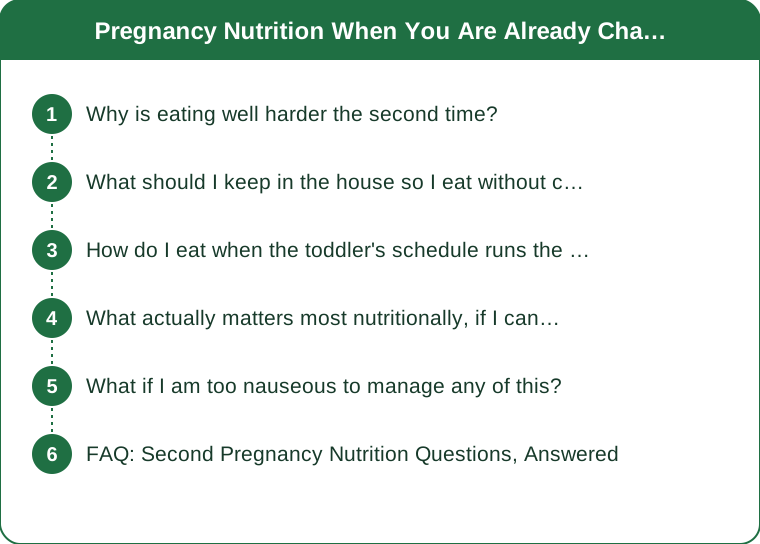
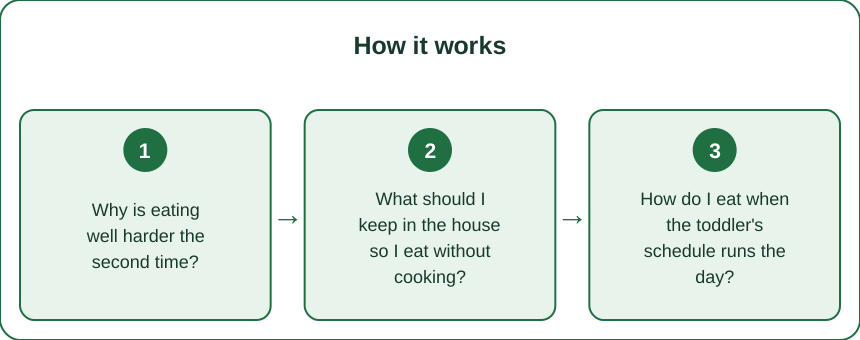
Why is eating well harder the second time?
Because the limiting factor changed, and none of the standard guidance accounts for it.
In a first pregnancy the constraints are typically nausea, aversions, and uncertainty about what is safe. Those are solvable with information and a bit of planning, and there is usually time and quiet to do that planning.
In a second pregnancy the same physical symptoms are there, and on top of them:
You are eating on someone else’s schedule. Toddler meals happen at fixed, early times. Your appetite does not align with them, and by the time you sit down there is often nothing left that appeals.
You are more tired, earlier. Fatigue in a second pregnancy is frequently reported as more intense, partly because it is layered on top of already-broken sleep and constant physical demand. Tired people cook less and snack more.
There is no rest period. In a first pregnancy the couch was available. Now the couch is a slide.
Nausea is harder to manage. The reliable fix for early nausea is eating small amounts frequently, and doing that requires being able to eat when you need to rather than when you can.
So the useful question is not what should I eat. It is what can I actually get into my hand at the moment I need it.
What should I keep in the house so I eat without cooking?
Things that require zero preparation and no decision, positioned where you will actually be.
The test for any item on this list is: can you eat it one-handed, standing up, in under thirty seconds?
For protein — the thing most commonly short:
- Greek yoghurt or skyr, individual pots. Around 15 to 20 grams of protein and it needs nothing.
- Cheese portions — babybel, cheese sticks, small blocks.
- Boiled eggs, cooked six at a time and kept in the fridge.
- Tinned fish — sardines, mackerel, salmon. Low mercury options, high in protein and omega-3.
- Roasted chickpeas, nuts, and seeds in a jar on the counter.
- Milk. Genuinely underrated. A glass of milk is fast protein and calcium.
For iron, which is commonly low in second pregnancies:
- Fortified breakfast cereal, eaten dry or with milk, at any time of day.
- Dried apricots, which are also convenient for the constipation that often comes with iron supplements.
- Tinned beans and lentils — straight from the tin into anything.
- Red meat when you cook, which is often the most bioavailable source.
- Pair plant iron sources with vitamin C — a satsuma, a glass of orange juice, tomatoes. This substantially improves absorption.
Positioning matters as much as the food. Keep a small stash where you actually are — the nappy bag, the car, the room where you spend most of the day. Food in the kitchen when you are upstairs might as well not exist.
How do I eat when the toddler’s schedule runs the day?
Stop fighting it and use it. The schedule is fixed; your relationship to it is not.
Eat with them, not after them. The single most effective change. Toddler lunch at 11:45 is early for an adult, and eating then is far better than eating nothing until two. Make your portion at the same time as theirs, on the same plate rotation.
Cook once for both. Most toddler food is perfectly good adult food with more seasoning. A pasta with hidden vegetables, a lentil bolognese, a fish pie — add chilli, herbs, or a squeeze of lemon to yours after serving theirs.
Use their snack times as your snack times. They are already stopping. Have the same fruit, add a handful of nuts or a yoghurt for yourself.
Accept the second dinner. Eating a small amount at 5pm with them and something else at 8pm is not a failure of planning; it is two eating occasions, which for pregnancy nausea is often better than one large one.
On nap time: the temptation is to use it for jobs. If your nutrition has slipped, use twenty minutes of one nap a week to boil eggs, cut fruit, and portion snacks. That twenty minutes covers more ground than any other twenty minutes in the week.
A note on the food you eat off their plate: it is fine, and it is also frequently not enough. Toddler leftovers are usually carbohydrate. If that is a large share of your intake, protein is the thing to add deliberately.

What actually matters most nutritionally, if I can only get a few things right?
Ask your midwife or doctor about your specific situation, since needs vary. In general terms, the things most commonly worth prioritising:
Your prenatal supplement, taken consistently. Folic acid in early pregnancy and vitamin D throughout are standard recommendations in most countries. Taking it at the same time as something you already do daily — the toddler’s breakfast, brushing your teeth — is what makes it consistent.
Iron. Iron requirements rise substantially in pregnancy, and second pregnancies, particularly those closely spaced, carry a higher likelihood of low stores. Your midwife will usually check this. Do not start iron supplements on your own; ask.
Protein, spread across the day. Requirements increase in the second and third trimesters. The practical target is including a protein source at every eating occasion rather than hitting a number, since spread matters and it is easier to think about.
Fluid. Easy to miss when you are busy, and dehydration worsens fatigue, headaches, and constipation. A bottle you refill and carry with you is more effective than any reminder.
Calcium and iodine, both of which have increased needs and both of which are largely covered by dairy or fortified alternatives.
What matters less than people think: perfection, superfoods, and eliminating things unnecessarily. Consistent adequate eating substantially outperforms occasional ideal eating.
This is general information and does not replace advice from your midwife, doctor, or a registered dietitian, particularly if you have any medical condition, a multiple pregnancy, or a history of low iron.
What if I am too nauseous to manage any of this?
Then the priority changes entirely, and it is a completely reasonable position to be in.
In active nausea, the goal is calories and fluid, not balance. Whatever stays down is the right food. Plain carbohydrates, cold food, dry food, bland food — all of it counts, and none of it needs justifying.
Things that commonly help:
- Eating small amounts very frequently. An empty stomach usually makes nausea worse, which is the cruel part.
- Something before you get out of bed — a plain biscuit or cracker on the bedside table.
- Cold food over hot. Less smell, and smell is often the trigger.
- Separating fluids from food, drinking between rather than with meals.
- Ginger, which has some evidence behind it and is worth trying.
With a toddler specifically: the smell of their food is a common trigger. It is entirely acceptable to serve them something cold, or something you do not have to be in the room for, for a few weeks.
When to seek help: if you cannot keep fluids down, are losing weight, are passing very little urine, or feel faint, contact your midwife or doctor promptly. Severe pregnancy sickness is a recognised medical condition and there are treatments — it is not something to endure. This is general information, not medical advice.
FAQ: Second Pregnancy Nutrition Questions, Answered
Do I need to eat more than in my first pregnancy?
Energy requirements are broadly similar for a singleton pregnancy, though many people find hunger patterns differ. The extra requirement in the second and third trimesters is modest — smaller than most people assume. Your midwife can advise on your specific situation.
Is it a problem if I am mostly eating my toddler’s leftovers?
Not inherently, but toddler food skews toward carbohydrate and away from iron and protein. If that is your main intake, the useful addition is protein and iron rather than a whole different approach. A yoghurt and a handful of nuts alongside covers a lot of ground.
Can I still take my prenatal if it makes me feel sick?
Many people find taking it with food, or in the evening rather than the morning, helps considerably. Different formulations vary too. Speak to your midwife or pharmacist rather than stopping it — there are usually workable alternatives.
How do I manage constipation, which is worse this time?
Fluid, fibre, and movement are the standard trio, and iron supplements commonly make it worse. Dried fruit, wholegrains, and pulses all help. If it is significant or painful, ask your midwife — there are pregnancy-safe options and it is a very common thing to raise.
Should I be worried that I am more tired than last time?
More fatigue in a second pregnancy is extremely common and largely explained by the circumstances. That said, significant fatigue can also indicate low iron or thyroid issues, both of which are checkable and treatable. It is worth mentioning rather than assuming it is just how it is. This is general information, not medical advice.
TL;DR:
- The constraint is time and energy, not knowledge. Most pregnancy nutrition advice is written for a first pregnancy.
- Keep zero-preparation protein within reach: yoghurt, cheese, boiled eggs, tinned fish, nuts, milk. Position it where you actually are.
- Eat with the toddler, not after them. Cook one meal, season yours after.
- Prioritise the prenatal supplement, iron, protein spread across the day, and fluid. Ask your midwife about iron rather than self-supplementing.
- Pair plant iron with vitamin C to improve absorption.
- In active nausea, calories and fluid beat balance. Whatever stays down counts.
Consistent adequate eating beats occasional ideal eating. This is general information and does not replace advice from your midwife or doctor.
See It in Motion
Seen here: Maternity Capris with Side Pockets — shop it on bubblelime.com
Keep Reading
This article is for general informational purposes only and is not medical advice. Always consult a qualified health professional for guidance specific to you.