Pregnancy Nutrition at Work: The Questions Nobody Puts in the Books
Quick Answer: The main workplace challenges are nausea that peaks at inconvenient times, hunger that arrives faster and more urgently than before, limited fridge and microwave access, and food safety questions in shared kitchens. The practical answers are the same across most jobs: keep a permanent desk stash, eat smaller amounts more often rather than three meals, and treat hydration as a scheduled task rather than something you get to. Below are the questions that actually come up, answered directly.
Every pregnancy nutrition guide assumes you are at home with a fridge, a stove, and control over your own schedule.
Most people are not. Here is the same information for a working day.

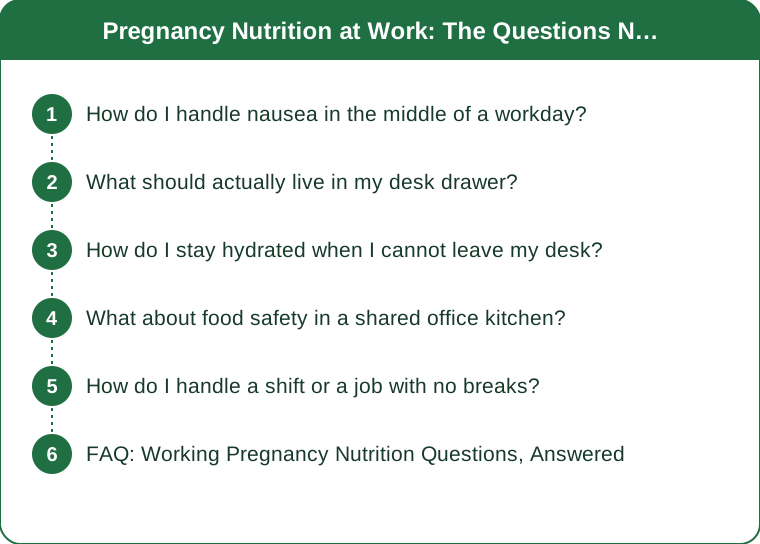
How do I handle nausea in the middle of a workday?
Eat before it starts, not after. Nausea in early pregnancy is frequently worse on an empty stomach, and the window between fine and unable to eat can be short.
The practical approach is to eat small amounts frequently rather than waiting for meals - roughly every two to three hours, even a few bites. Plain, dry, and bland foods are generally best tolerated: crackers, plain toast, dry cereal, pretzels, rice cakes.
A desk stash is what makes this possible. Keep a small container of dry crackers in a drawer permanently, so there is always something within reach without a trip anywhere.
Smells are a major trigger and a workplace-specific problem, since you do not control the microwave or the person eating fish at the next desk. Strategies that help: eating somewhere with fresh air, keeping a lemon or a mint to sniff, and stepping outside for a few minutes when a smell hits.
Ginger has reasonable evidence for helping with pregnancy nausea, and vitamin B6 is often suggested. Both are worth discussing with your midwife or doctor rather than starting on your own. If you are unable to keep fluids down or losing weight, that needs medical attention promptly rather than a workplace strategy. This is general information, not medical advice.
What should actually live in my desk drawer?
The stash needs to be shelf-stable, quiet to eat, and require no preparation. That narrows it usefully.
The core five:
- Plain crackers or rice cakes - the nausea baseline
- Nuts and seeds - protein and fat, which is what actually stops the two-hour hunger cycle
- Dried fruit - iron in apricots, quick energy, long shelf life
- Individual nut butter sachets - protein that pairs with the crackers
- Wholegrain cereal or a plain oat bar - fibre, which matters given how common constipation is in pregnancy
Worth adding if you have a fridge: Greek yoghurt, cheese portions, hummus, hard-boiled eggs, and cut vegetables.
What does not work well: anything that needs a plate, anything strongly smelling, and anything that requires you to leave the building. The whole point is that it is available in the ninety seconds before a meeting.
Restock it on a fixed day. A stash that runs out on a Wednesday and gets refilled the following Monday is not a system.
How do I stay hydrated when I cannot leave my desk?
Treat it as a scheduled task, because the natural cues do not work well in an office.
Fluid needs increase during pregnancy - blood volume rises substantially - and dehydration contributes directly to headaches, fatigue, constipation, and in later pregnancy can trigger Braxton Hicks contractions.
What works in practice:
- A large bottle on the desk, filled twice a day. Visible and refilled at fixed points beats intention.
- Link it to something that already happens. A glass with every meeting, or every time you sit back down.
- Cold or room temperature, whichever you tolerate. In nausea, many people find cold water and sipping much easier than gulping.
- Count other fluids. Milk, herbal teas, soups, and water-rich fruit all contribute.
The bathroom-frequency trade-off is real and it is the reason many people quietly under-drink at work. It is worth deciding deliberately that the frequent trips are the acceptable cost, because the alternative - a headache and fatigue by three in the afternoon - is worse and lasts longer.

What about food safety in a shared office kitchen?
This comes up constantly and it is rarely addressed.
The office fridge is the main issue. Communal fridges are often not cold enough and are opened constantly. Keeping your food in an insulated bag with an ice pack inside the fridge is a reasonable precaution, and it also stops your lunch absorbing other smells.
Reheating matters more than usual. Leftovers should be reheated until steaming hot throughout, not merely warm - which means a proper microwave cycle rather than the ninety seconds most people use. This is the practical reason cold leftovers are often the safer workplace option unless you can reheat properly.
The foods to avoid in pregnancy are the same at work as anywhere, and the shared-kitchen risk is that they arrive unlabelled - communal cheese boards, someone’s homemade dessert, a birthday cake with a soft-cheese icing. It is entirely reasonable to ask what is in something.
Two hours is the guideline for leaving perishable food at room temperature - less in a warm office. A lunch that has sat on a desk since morning is the common failure point, which is another argument for the insulated bag.
For the specific list of foods to avoid, follow your local health service guidance and your midwife’s advice rather than general articles. This is general information, not medical advice.
How do I handle a shift or a job with no breaks?
Shift work, teaching, healthcare, retail, and any role without predictable breaks makes all of this harder, and generic advice mostly ignores it.
Eat on the clock where you can. Small handfuls of nuts or a few crackers between tasks, rather than waiting for a break that may not come at a useful time.
Front-load the day. If breaks are unpredictable, a substantial breakfast before the shift is more reliable than a planned mid-shift meal.
Carry it on you. A small pocket or bag stash rather than something in a locker two floors away.
Night shifts need a plan of their own. Eating a full meal in the middle of a night shift often sits badly; smaller amounts across the shift usually work better, with the main meal before it.
Know your legal position. In many places, pregnant employees are entitled to additional breaks, adjustments to duties, and somewhere to rest. Requirements vary by country and employer, and it is worth checking your specific entitlements rather than assuming there are none - many people do not ask because they do not know they can.
If you are struggling to eat or drink adequately across a shift pattern, that is worth raising with your midwife or occupational health rather than managing alone.
FAQ: Working Pregnancy Nutrition Questions, Answered
Do I actually need to eat more?
Less than most people assume in the first trimester - additional energy needs are modest early on and increase in later pregnancy. What changes more is the pattern: smaller, more frequent eating usually works better than three larger meals, particularly with nausea or later when there is less room in the stomach. Follow your midwife’s guidance on your specific situation.
Is coffee at work still allowed?
Guidance generally sets a daily caffeine limit during pregnancy, and it is worth checking your local recommendation, since office coffee is often much stronger than expected. Remember tea, cola, and chocolate contribute too.
How do I explain frequent snacking to colleagues?
You do not owe anyone an explanation, particularly before you have announced. Practically, a drawer stash and small quiet snacks attract very little attention, and most people are far less observant than the anxiety suggests.
What if I cannot face any of my usual foods?
Extremely common, and it usually shifts by the second trimester. Eat what you can tolerate in the meantime - a period of blander, narrower eating does not undo an otherwise reasonable diet. Persistent inability to eat, or weight loss, should go to your midwife or doctor. This is general information, not medical advice.
TL;DR:
- Eat before nausea starts, in small amounts every two to three hours rather than waiting for meals.
- Keep a permanent desk stash: crackers, nuts, dried fruit, nut butter sachets, oat bars. Restock on a fixed day.
- Treat hydration as a scheduled task - a large visible bottle, refilled at fixed points, linked to something you already do.
- Use an insulated bag inside the office fridge, and reheat until steaming rather than warm.
- For shifts without predictable breaks, front-load the day and carry food on you.
- Check your workplace entitlements - many people are eligible for breaks and adjustments they never ask for.
Most pregnancy nutrition advice assumes a kitchen and a flexible day. The version that works at a desk is mostly about having food within arm’s reach before you need it. This is general information, not medical advice.
See It in Motion
Seen here: Maternity Capris with Side Pockets — shop it on bubblelime.com
Keep Reading
This article is for general informational purposes only and is not medical advice. Always consult a qualified health professional for guidance specific to you.