Fourth Trimester Nutrition Questions Nobody Answers Clearly While You're Breastfeeding
Quick Answer: Most breastfeeding parents need roughly 300-500 additional calories daily, prioritized around protein, iron, and hydration rather than any single ‘lactation food,’ and the biggest nutrition mistakes in the fourth trimester come from under-eating during a genuinely exhausting stretch, not from eating the wrong things.
The fourth trimester comes with an overwhelming amount of generic advice (‘eat more,’ ‘stay hydrated’) and very few direct answers to the specific questions new parents actually have at 3am with a baby attached to them.

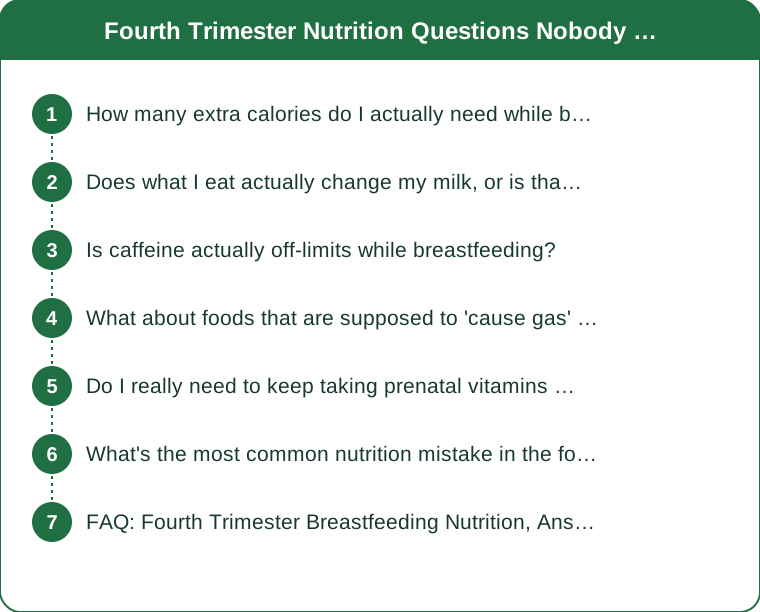
How many extra calories do I actually need while breastfeeding?
Most exclusively breastfeeding parents need roughly 300-500 additional calories per day above their pre-pregnancy baseline, though this varies with body size, activity level, and whether you’re feeding one baby or twins. Under-eating is far more common than over-eating in this window, largely because exhaustion makes consistent meals hard to prioritize, not because appetite naturally drops.
Does what I eat actually change my milk, or is that overstated?
Overall diet quality affects the fat composition and certain micronutrients in breast milk more than it affects total milk volume, which is driven primarily by feeding frequency and demand rather than diet. This means occasional less-than-ideal meals won’t meaningfully harm supply, but a consistently low-protein or low-calorie pattern over weeks can.
Is caffeine actually off-limits while breastfeeding?
No — moderate caffeine intake (roughly the equivalent of 2-3 cups of coffee) is generally considered fine while breastfeeding, since only a small fraction passes into breast milk. Newborns, especially in the first few weeks, may be more sensitive to it than older babies, so watching for unusual fussiness after caffeine is a reasonable individual check.

What about foods that are supposed to ‘cause gas’ in the baby?
The idea that broccoli, beans, or spicy food directly cause gas in a breastfed baby has very limited scientific support — most infant gas and fussiness stems from swallowing air during feeding or normal digestive immaturity, not maternal diet. If you notice a consistent pattern after a specific food over several instances, it’s reasonable to test removing it, but broad restriction without evidence usually isn’t necessary.
Do I really need to keep taking prenatal vitamins postpartum?
Yes, generally — continuing a prenatal or postnatal vitamin through breastfeeding helps cover nutrient gaps (particularly iron, vitamin D, and DHA) that are easy to miss when meals are irregular and sleep-deprived. This isn’t a replacement for eating real food, but it’s a reasonable backstop for a period when consistent meals are genuinely hard.
What’s the most common nutrition mistake in the fourth trimester?
Skipping meals entirely during long stretches of newborn care, rather than eating the ‘wrong’ foods, is the most common issue — low blood sugar from under-eating can worsen fatigue and mood in a period already taxed by sleep deprivation. Keeping easy, one-handed snacks (nuts, cheese sticks, fruit) within reach addresses this more effectively than any specific meal plan.
FAQ: Fourth Trimester Breastfeeding Nutrition, Answered
Do I need to drink a specific amount of water for milk supply?
Drinking to thirst is generally sufficient — forcing large amounts of extra water beyond that doesn’t meaningfully increase supply, contrary to common advice.
Are lactation cookies and teas actually necessary?
They’re not necessary for adequate supply in most cases, though some parents find the routine of eating regularly (which the products encourage) more helpful than the specific ingredients.
When should I talk to a doctor about nutrition concerns postpartum?
If you notice unintentional rapid weight loss, persistent low energy despite eating, or signs of low milk supply alongside inadequate intake, that’s worth raising with a doctor or lactation consultant rather than adjusting alone. This is general information, not medical advice.
TL;DR:
- Most breastfeeding parents need roughly 300-500 extra calories daily, prioritized around protein and iron
- Diet quality affects milk composition more than total volume, which is driven by feeding frequency
- Moderate caffeine is generally fine; food-based baby gas theories have limited evidence
- Skipping meals during exhausting stretches is the most common and most fixable mistake
Keep easy one-handed snacks within reach — it solves more fourth-trimester nutrition problems than any specific food list.
See It in Motion
Seen here: Maternity Capris with Side Pockets — shop it on bubblelime.com
Keep Reading
This article is for general informational purposes only and is not medical advice. Always consult a qualified health professional for guidance specific to you.