Eating Out While Pregnant: The Questions You Would Rather Not Ask the Waiter
Quick Answer: Most restaurant food is fine in pregnancy. The main things to check are undercooked meat and eggs, unpasteurised dairy, certain soft cheeses, high-mercury fish, cured and pre-sliced meats, and buffet items held at uncertain temperatures. When in doubt, ask for it well cooked and freshly prepared - and check current guidance for your country, because recommendations differ.
The awkwardness of eating out while pregnant is not usually the food itself. It is not knowing which questions are reasonable to ask, and feeling conspicuous asking them.

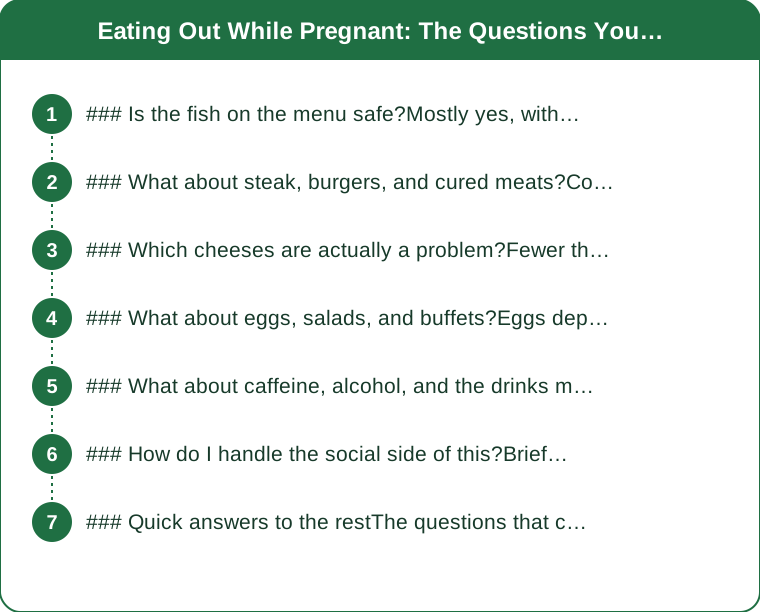
### Is the fish on the menu safe?
Mostly yes, with specific exceptions worth knowing. The mercury question. Larger, longer-lived predatory fish accumulate more mercury. Guidance in most countries advises avoiding shark, swordfish, marlin, and king mackerel, and limiting tuna - typically a couple of portions a week of fresh tuna, with tinned tuna often allowed more freely because it tends to be from smaller species.
Fish that are generally encouraged: salmon, cod, haddock, plaice, sardines, trout, prawns, and most white fish. Oily fish is recommended in pregnancy for omega-3s, commonly at one to two portions a week.
The raw question. Sushi, sashimi, ceviche, and raw oysters carry a risk of parasites and bacteria.
- Guidance differs by country, which causes real confusion. UK advice has generally allowed sushi if the fish has been commercially frozen first, which kills parasites and is standard practice for sushi-grade fish. US guidance has been more cautious about raw fish generally.
- Cooked sushi is uncontroversial - cooked prawn, eel, egg, and vegetable rolls
- Raw shellfish, particularly oysters, is the one most consistently advised against everywhere, because of bacterial risk
Smoked fish - cold-smoked salmon and gravlax - has been treated cautiously in some guidance because of listeria risk, though several countries have relaxed this. Hot-smoked fish, such as smoked mackerel, is cooked and not a concern.
The practical restaurant approach: order fish cooked through, choose from the encouraged list, and treat sushi according to your own country’s current guidance and your comfort level.
### What about steak, burgers, and cured meats?
Cooking temperature is the deciding factor, and cured meat is a separate question. Steak and burgers. Undercooked meat carries a risk of toxoplasmosis and other infections.
- Order steak well done. Not medium, not medium-well. This is one of the few genuinely non-negotiable restaurant adjustments, and it is worth being explicit about because kitchens interpret doneness differently.
- Burgers must be cooked through - minced meat mixes any surface bacteria throughout, which is why a rare burger is riskier than a rare steak
- Chicken and pork cooked through, which they should be anyway
Cured and pre-sliced meats. Parma ham, salami, chorizo, prosciutto, and similar.
- These are cured rather than cooked, so they carry a toxoplasmosis risk
- UK guidance has suggested freezing cured meats at home for four days before eating to kill parasites, which is not something a restaurant will have done
- Cooked ham and cooked chicken slices are fine
- Cured meat cooked on a pizza - chorizo or pepperoni that has been through the oven - is generally considered fine, since it has been cooked
Pâté is advised against in most guidance, including vegetable pâté, because of listeria risk.
What to order instead when the menu is meat-heavy: anything grilled, roasted, or braised and served hot. The safe list is far longer than the list to avoid, which is easy to lose sight of when reading about it.
### Which cheeses are actually a problem?
Fewer than most people think, and the rule is about mould and pasteurisation rather than softness. Generally advised against:
- Mould-ripened soft cheeses - brie, camembert, chevre with a white rind - because of listeria risk
- Soft blue cheeses - roquefort, gorgonzola, danish blue
- Any unpasteurised soft cheese
Generally fine:
- Hard cheeses, pasteurised or not - cheddar, parmesan, manchego, gruyere. Hard cheese is low risk even when unpasteurised, because the low moisture content does not support listeria growth.
- Pasteurised soft cheeses without mould rinds - mozzarella, feta, ricotta, cream cheese, cottage cheese, halloumi, paneer, processed cheese
- Hard blue cheeses, such as stilton, in some guidance - worth checking your local advice
The important exception: cooked. Baked camembert, brie in a cooked tart, or blue cheese melted into a sauce is generally considered fine, provided it is thoroughly cooked and piping hot throughout. Heat kills listeria.
In a restaurant:
- Ask whether the goat’s cheese is pasteurised and whether it has a rind. A perfectly ordinary question, and kitchens are asked it constantly.
- The cheeseboard is the hardest item - assume the soft ones are off unless someone can confirm otherwise
- Parmesan on pasta is fine. It is hard cheese, and in most countries the pasteurisation question does not change that.
Why this rule exists at all: listeria is rare and can cause serious complications in pregnancy, which is why guidance is cautious about a food that is otherwise low risk.

### What about eggs, salads, and buffets?
Eggs depend on your country, and buffets are about temperature and time. Eggs. This is one of the biggest differences between countries.
- In the UK, eggs with the British Lion mark are considered safe to eat runny or raw during pregnancy, following a change in guidance based on reduced salmonella risk. Non-Lion and imported eggs should be cooked through.
- In the US and several other countries, guidance remains that eggs should be cooked until both white and yolk are firm.
- This affects: poached and fried eggs, hollandaise, homemade mayonnaise, mousse, tiramisu, and raw cookie dough
Practically in a restaurant: unless you can be confident of the egg source, ordering eggs cooked through is the straightforward option. Commercially produced mayonnaise and dressings are made with pasteurised egg and are fine.
Salads. The concern is washing rather than the ingredients.
- Restaurant salads are generally fine - commercial kitchens wash produce
- Pre-packed salads and buffet salads that have been sitting out are the more cautious category
- Sprouted seeds - alfalfa, bean sprouts - are advised against raw in several countries, because the growing conditions suit bacteria. Cooked sprouts, as in a stir fry, are fine.
Buffets. The concern is time and temperature.
- Hot food should be piping hot, not warm. If it has been under a lamp for an unknown period, skip it.
- Cold food should be properly chilled
- Freshly cooked to order beats a buffet whenever the option exists
- Rice left standing carries a specific risk from bacillus cereus, which is why reheated rice comes with warnings generally
### What about caffeine, alcohol, and the drinks menu?
Caffeine has a limit, alcohol has no established safe level, and the rest is straightforward. Caffeine. Most guidance sets a limit of 200mg per day in pregnancy, associated with reducing risk of low birth weight and miscarriage.
Rough amounts:
- Filter coffee: around 140mg per mug
- Espresso shot: around 60 to 80mg
- Instant coffee: around 100mg
- Tea: around 75mg per mug
- Green tea: around 30 to 50mg
- Cola: around 40mg per can
- Energy drinks: often 80mg or considerably more, and generally advised against in pregnancy
- Dark chocolate: around 25mg per 50g
The practical version: two mugs of tea or one coffee plus a tea is roughly the daily allowance. Restaurant coffee is often stronger and larger than a home mug, so a single large coffee out can approach the whole limit.
Alcohol. Current guidance in the UK, US, and most countries is that no level of alcohol has been established as safe in pregnancy, and the recommendation is to avoid it entirely.
- Cooking does not remove all alcohol from a dish, though the amounts remaining in a sauce are small
- Alcohol-free beers and wines typically contain a trace amount, up to 0.5 percent. Most guidance considers these acceptable; check your own comfort level.
- Ordering something specific helps socially - a soft drink you actually want in a nice glass reduces questions considerably
Herbal teas - most are fine in moderation, and a few are advised against in pregnancy. Raspberry leaf tea in particular is often advised against before late pregnancy. Worth checking specific herbs rather than assuming herbal means harmless.
Unpasteurised juices at juice bars are worth asking about; commercial juices are pasteurised.
### How do I handle the social side of this?
Briefly, without explaining yourself, and with a plan made before you arrive. Look at the menu before you go. Nearly every restaurant posts it online. Deciding in advance removes the pressure of choosing while everyone else is ready, and it means you arrive knowing there are two or three things you can have.
Ask questions plainly. Is that pasteurised? and Could I have that well done? are unremarkable requests that kitchens handle daily. You do not owe anyone an explanation, particularly if you have not announced the pregnancy.
If you are keeping it private:
- Order first, so nobody notices you avoiding the wine
- A soft drink in a wine glass does not attract attention
- Driving is the universally accepted reason to skip alcohol and nobody questions it
- Antibiotics is the other classic, and equally unremarkable
On the nausea problem, which is the more common practical issue in the first trimester:
- Order something plain and let others order the interesting things. Bread, plain pasta, plain rice, and potatoes are frequently the only appealing options and there is no shame in that.
- Ask for sauces on the side, since smell is often the trigger rather than taste
- Sit near a window or away from the kitchen if cooking smells are difficult
- Eat something before you go so an empty stomach is not making it worse
The broader point worth holding onto: the list of foods to avoid is short, the list of foods that are fine is enormous, and anxiety about eating out is more common than any of the actual risks involved. If you have eaten something on the avoid list, it is very unlikely to have caused harm - mention it at your next appointment rather than worrying alone.
Guidance differs by country and changes over time. Check your national health service’s current advice, and speak to your midwife or doctor about anything specific to your pregnancy.
### Quick answers to the rest
The questions that come up most often, in short form.
Can I eat takeaway sushi?
Cooked rolls are uncontroversial. Raw fish depends on your country’s guidance - the UK has generally allowed it if commercially frozen first, the US is more cautious. Check current local advice.
Is a rare steak ever fine?
No current guidance supports it in pregnancy. Order well done.
What about a cheese board?
Skip soft mould-ripened and soft blue cheeses. Hard cheeses are fine, including unpasteurised ones.
Are restaurant desserts a problem?
Mousse, tiramisu, and homemade ice cream may contain raw egg - worth asking. Commercially produced ice cream and baked desserts are fine.
What if I ate something from the avoid list before I knew?
The individual risk from any single exposure is very low. Mention it at your next appointment rather than worrying about it. This is general information, not medical advice - always follow the guidance from your own healthcare provider and national health service.
TL;DR:
- Order meat well done, fish cooked, and avoid raw shellfish and high-mercury fish
- Skip mould-ripened and soft blue cheeses unless thoroughly cooked; hard cheeses are fine
- Egg guidance differs by country - cooked through is the straightforward restaurant answer
- Caffeine limit is around 200mg daily, which one large restaurant coffee can nearly reach
- Check the menu before you go, ask questions plainly, and remember the safe list is far longer than the avoid list
Most of eating out in pregnancy is unremarkable once you know the handful of items to watch. Guidance varies between countries and changes over time, so check your own national advice, and take anything specific to your pregnancy to your midwife or doctor. This is general information, not medical advice.
Keep Reading
This article is for general informational purposes only and is not medical advice. Always consult a qualified health professional for guidance specific to you.