Late Summer Pregnancy Hydration: Your Questions Answered
Quick Answer: Pregnancy raises your fluid needs by roughly 300ml a day on top of a normal baseline, and hot weather can double the gap through sweat losses. Most guidance lands around 2.3 to 3 litres of total fluid daily during pregnancy, more in heat - and the practical test is urine colour, not counting glasses. Pale straw is the target. This is general information, not medical advice.
August plus a third trimester is a specific combination, and the usual advice to drink when you are thirsty stops being reliable.

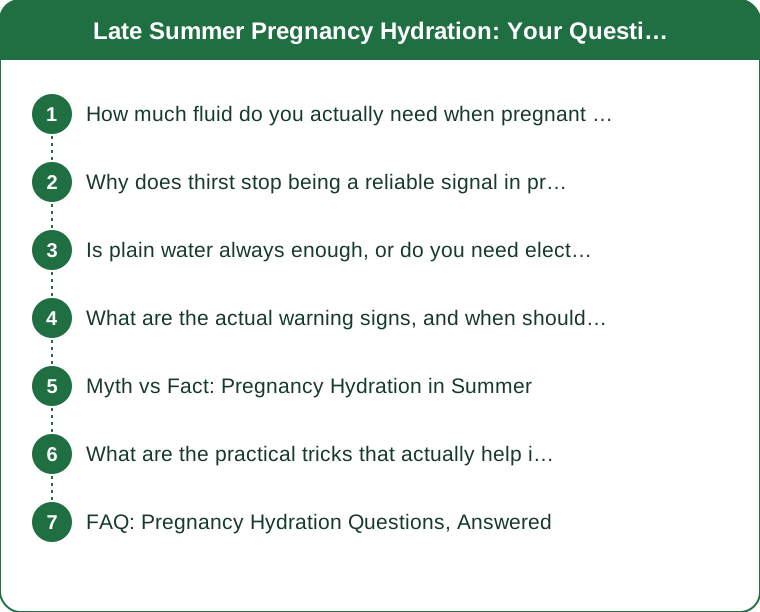
How much fluid do you actually need when pregnant in hot weather?
The commonly cited pregnancy figure is around 2.3 to 3 litres of total fluid a day, which includes fluid from food - typically about 20% of intake - not just what you drink.
Pregnancy increases the requirement for identifiable reasons: blood volume rises substantially, amniotic fluid needs replacing continuously, and metabolic rate increases, which raises baseline fluid turnover.
Heat adds to that on top. Sweat losses during moderate activity in hot weather can run half a litre to a litre an hour, and pregnant bodies typically run warmer and sweat sooner than they did before.
Why the number is less useful than it sounds: requirements vary with body size, activity, humidity, and whether you are managing nausea or vomiting. Chasing a fixed litre target can push you into drinking more than you need, which has its own risks.
The practical approach: aim for pale straw urine, drink steadily rather than in large boluses, and increase deliberately on hot days and after any activity rather than trying to hit a number.
Why does thirst stop being a reliable signal in pregnancy?
Several things blunt it at once, which is why waiting until you feel thirsty is poor guidance in a hot pregnancy.
Thirst lags behind actual fluid loss. By the time you feel meaningfully thirsty, you are typically already somewhat behind - and that lag exists for everyone, not only in pregnancy.
Pregnancy shifts the thresholds that trigger thirst. Hormonal changes in pregnancy alter the osmotic set point at which the body registers thirst and conserves water, which is part of why the normal signal feels less sharp.
Nausea competes with it directly. If drinking makes you feel sick, thirst gets overridden by aversion - and this is a common reason for dehydration in the first trimester specifically.
Frequent urination discourages drinking. Many people quietly reduce fluids to reduce bathroom trips, particularly in the third trimester or before travel and long meetings. This is one of the most common causes of avoidable dehydration in late pregnancy, and it works against you - concentrated urine irritates the bladder and can increase urgency rather than reduce it.
What to do instead of relying on thirst: attach drinking to routine events. A glass on waking, one with each meal, one at each bathroom trip, one before bed. Routine beats sensation when the sensation is unreliable.
Is plain water always enough, or do you need electrolytes?
For most days, plain water plus a normally salted diet is sufficient. There are specific situations where it is not.
Water alone can be inadequate when:
- You have been sweating heavily for more than about an hour
- You have had vomiting or diarrhoea
- You are drinking large volumes and still feel unwell, headachy, or notice muscle cramps
- You are outdoors in high heat for extended periods
What is happening in those cases: you are losing sodium along with water, and replacing only the water dilutes what is left. This is why drinking more and more plain water while feeling progressively worse is a warning sign rather than a solution.
Practical options: an oral rehydration solution, a sports drink diluted with water, or simply water plus salty food. Coconut water, broth, and a salted snack alongside water all work - the mechanism is sodium, not any particular product.
On caffeine: current guidance in pregnancy generally caps caffeine around 200mg a day, roughly one 12oz coffee. Caffeinated drinks still contribute to hydration despite the persistent belief that they are dehydrating - the mild diuretic effect does not outweigh the fluid volume. The caffeine limit is about caffeine, not about hydration.
Anything with unusual electrolyte loads, supplements, or high-sodium formulations should be run past your midwife or doctor first, particularly if you have blood pressure concerns. This is general information, not medical advice.

What are the actual warning signs, and when should you call someone?
This is the part worth reading properly, because heat and dehydration in pregnancy have a genuine escalation path.
Mild dehydration - drink, rest, cool down:
- Dark yellow urine, or noticeably reduced output
- Dry mouth, mild headache
- Feeling more tired than the day warrants
Call your midwife or doctor:
- Dizziness or feeling faint on standing that does not resolve with fluids and rest
- Marked reduction in urination over several hours
- Persistent headache that does not improve
- Vomiting that prevents you keeping fluids down for more than a few hours
- Contractions or tightening - dehydration can trigger Braxton Hicks contractions, and this is a common reason people are advised to hydrate and rest
Seek urgent care:
- Reduced fetal movement compared with your normal pattern
- Confusion, fainting, or a rapid pounding heartbeat
- Severe headache with visual changes or swelling - this pattern needs same-day assessment because it overlaps with signs of pre-eclampsia rather than simple dehydration
- Any sign of heat exhaustion or heat stroke: hot dry skin, stopping sweating, high temperature
The rule that matters: symptoms that overlap between dehydration and something more serious - headache, swelling, visual changes, reduced movement - should be assessed rather than treated at home with a glass of water. Getting it checked and being told it was dehydration is a completely reasonable outcome. This is general information and not a substitute for advice from your own care team.
Myth vs Fact: Pregnancy Hydration in Summer
Myth: Swelling means you are drinking too much water, so cut back. Fact: Mild swelling in late pregnancy is normal and heat makes it worse; reducing fluids typically does not help and can make you feel considerably worse. Sudden or severe swelling, particularly in the face and hands, is a different matter and needs assessment.
Myth: You should drink as much water as possible to be safe. Fact: Excessive water intake without sodium can dilute blood sodium levels, which is a real if uncommon problem. More is not automatically better - steady and adequate is the target.
Myth: Cold drinks are bad for the baby. Fact: There is no basis for this. Cold drinks are fine and are more palatable in heat, which means you drink more of them.
Myth: Coffee and tea do not count towards your fluid intake. Fact: They do. The caffeine limit exists for other reasons, but caffeinated drinks are net hydrating.
Myth: If you are not thirsty you are fine. Fact: Thirst is a lagging and blunted signal in pregnancy, which is the entire reason for building a routine instead.
Myth: Hydration only matters for you. Fact: Amniotic fluid volume is affected by maternal hydration, and low fluid levels are something care teams monitor. It is one of the few things where drinking water is a genuinely useful intervention, which is why it is so often the first advice given.
What are the practical tricks that actually help in heat?
Small logistics, because the problem is rarely knowledge and usually follow-through.
Make it cold and make it available. An insulated bottle that keeps water genuinely cold for hours materially increases how much people drink in heat. Warm water in a plastic bottle does the opposite.
Use food as fluid. Watermelon, cucumber, oranges, berries, soup, yoghurt. Food is roughly a fifth of total intake and it is the easiest fifth to increase - particularly useful if nausea makes drinking difficult.
Freeze fruit into ice cubes. Trivial, but it makes plain water interesting when you are sick of it, which is a real problem by week thirty.
Front-load the day. Drink more in the morning and taper in the evening. You get the same total with fewer overnight bathroom trips - restricting fluids entirely in the evening is the wrong fix for the same problem.
Shift activity out of the middle of the day. Early morning or evening for anything outdoors. Overheating is its own risk in pregnancy, separate from dehydration, and the simplest control is timing.
Keep the electrolyte option in the house before you need it. Rehydration sachets on a shelf are useful; a trip to the shop while feeling faint is not.
Track for three days if you are unsure. Not forever - just long enough to find out whether you are drinking 1 litre or 3, because most people’s estimate is wrong by a lot.
FAQ: Pregnancy Hydration Questions, Answered
Does hydration affect amniotic fluid levels?
Maternal hydration status does influence amniotic fluid volume, and increasing fluid intake is frequently the first suggestion when levels look low on a scan. Discuss any scan finding with your care team rather than self-managing it.
Can dehydration cause contractions?
Dehydration is a recognised trigger for Braxton Hicks tightening. If contractions are regular, painful, or before 37 weeks, contact your care team rather than assuming it is fluid-related.
Is it normal to be thirstier at night in pregnancy?
Common, yes - particularly in heat and in later pregnancy. Persistent excessive thirst alongside frequent urination is worth mentioning to your midwife, as it is one of the things gestational diabetes screening looks at.
Should I be using rehydration sachets routinely?
Not routinely. They are useful after heavy sweating, vomiting, or diarrhoea. Daily use without a reason is unnecessary and adds sodium you may not need.
How do I drink enough when everything makes me nauseous?
Small sips frequently rather than glasses, very cold or with ice, and lean on high-water foods. If you cannot keep fluids down for several hours, that is a call-your-care-team situation, not a push-through one.
TL;DR:
- Pregnancy raises fluid needs, and summer heat raises them again - roughly 2.3 to 3 litres total, more on hot days
- Thirst is a blunted, lagging signal in pregnancy; build a routine instead of waiting for it
- Plain water is enough most days, but add sodium after heavy sweating, vomiting or diarrhoea
- Pale straw urine is a better guide than counting glasses
- Headache with visual changes, reduced fetal movement, or sudden swelling need assessment, not more water
This is general information, not medical advice - anything that worries you is worth a phone call.
See It in Motion
Seen here: Maternity Capris with Side Pockets — shop it on bubblelime.com
Keep Reading
This article is for general informational purposes only and is not medical advice. Always consult a qualified health professional for guidance specific to you.