First Trimester Eating When Everything Sounds Terrible: Your Questions Answered
Quick Answer: In the first trimester, eating something is more important than eating well, and the baby’s nutritional demands at this stage are small relative to later pregnancy. Cold, bland, dry, and salty foods are tolerated best because they carry less aroma. Keep something in your stomach every two to three hours, take the prenatal at night or with food, and prioritize fluids over solids on the worst days. Aversions typically ease between weeks 12 and 16. Persistent vomiting that prevents keeping fluids down is a medical issue, not a coping problem.
The advice you get is all about salmon and leafy greens, and you cannot look at a vegetable. Here is what people actually want to know.

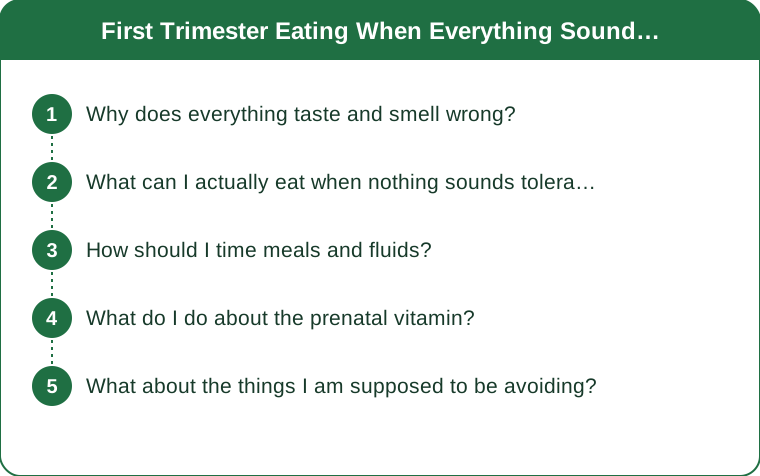
Why does everything taste and smell wrong?
What is causing it?
Rising hCG and estrogen in early pregnancy are strongly associated with nausea and altered taste and smell, and heightened smell sensitivity in particular is one of the earliest changes people notice. Some researchers view aversions as protective - a mechanism that steered people away from potentially risky foods at the most vulnerable stage of development. Whether or not that is the reason, the effect is real and it is not in your head.
Why is it worse with foods I loved?
Strongly flavoured and strongly aromatic foods are the usual casualties - coffee, meat, garlic, onion, and fish top most lists. Foods you ate often before pregnancy are also foods you have strong associations with, and a single bad experience with one during nausea can create a lasting aversion that outlives the trimester.
When does it stop?
Most people see substantial improvement between weeks 12 and 16, as hCG levels fall from their peak. A minority carry aversions further, and some carry one or two right through. Improvement is usually gradual rather than a switch flipping.
What can I actually eat when nothing sounds tolerable?
What foods are best tolerated?
The pattern across most people is cold, dry, bland, and salty. Cold food gives off less aroma, which matters enormously when smell is the trigger. Practical options:
- Plain crackers, dry cereal, plain toast, rice cakes
- Cold pasta or potato salad, plain rice
- Watermelon, grapes, apple slices, cold tinned peaches
- Cheese, plain yogurt, cottage cheese
- Crisps and pretzels - genuinely useful here, salt included
- Cold sandwiches with mild fillings
- Smoothies, if the texture works for you
Should I worry that my diet is terrible right now?
In the first trimester, no - within reason. The developing embryo is small and the additional energy requirement at this stage is close to zero. What matters most is folate, which your prenatal covers, and staying hydrated. A few weeks of crackers and cheese will not undo a pregnancy.
How do I get protein in when meat is out?
Cold, mild sources work best: cheese, yogurt, cottage cheese, hummus, nut butters, boiled eggs if eggs are tolerated, and milk or milk-based smoothies. Beans in a cold salad are sometimes tolerated when hot bean dishes are not, because of the aroma difference.
Is there any evidence for ginger?
Ginger has reasonable evidence for reducing nausea in pregnancy and is widely considered safe in food amounts. Ginger tea, crystallised ginger, or ginger biscuits are worth trying. It does not work for everyone.

How should I time meals and fluids?
Why does an empty stomach make it worse?
Nausea reliably worsens when the stomach is completely empty, which is why it is often worst first thing in the morning after an overnight gap. Low blood sugar compounds it.
What is the timing pattern that helps?
- Eat something before you get up. Keep crackers by the bed and eat a few before your feet touch the floor, then wait ten minutes.
- Small amounts every two to three hours, rather than three meals. Large volumes are harder to tolerate and trigger reflux.
- Separate fluids from solids by about 30 minutes. Filling the stomach with liquid alongside food often makes nausea worse.
- Something before bed - a small carbohydrate and protein snack reduces how empty you wake up.
What if I cannot keep fluids down?
This is the threshold that changes the answer. Dehydration is the main risk in first-trimester sickness, and if you cannot keep fluids down for more than about 24 hours, or you are passing very little dark urine, feeling dizzy on standing, or losing weight, contact your provider. Severe persistent vomiting - hyperemesis gravidarum - is a recognised medical condition with real treatments, and it is not something to push through alone.
What fluids are easiest?
Cold, and sipped rather than gulped. Ice chips, ice lollies, diluted juice, and electrolyte drinks all count. Some people tolerate carbonated water better than still, and some the reverse - test rather than assume.
What do I do about the prenatal vitamin?
Why does it make me feel worse?
Iron is the usual culprit - it is a common cause of nausea and stomach upset, and prenatal vitamins are iron-rich. The size of the tablet and the coating can also contribute.
What can I change?
- Take it at night, right before sleep, so you sleep through the peak effect. This is the single most effective change for most people.
- Take it with food, never on an empty stomach.
- Split it if it is a two-tablet dose - one morning, one evening.
- Ask about a different formulation. Gummy prenatals, smaller tablets, and lower-iron versions exist. Note that gummies usually contain no iron, so ask your provider whether you need iron separately.
- If you can only manage one thing, folate matters most in the first trimester. A standalone folic acid supplement is far better than nothing while you sort out the rest, and your provider can advise on the right approach.
Should I stop taking it if it makes me sick?
Talk to your provider rather than simply stopping. There is almost always a workable alternative, and the conversation is a routine one they have constantly.
This is general information, not medical advice. Anything about supplements, medications, or persistent symptoms should go to your own midwife or doctor.
What about the things I am supposed to be avoiding?
I only want the things on the avoid list. Is that normal?
Extremely. Cravings for soft cheese, cured meats, and rare steak during a period when strong flavours are otherwise intolerable is one of pregnancy’s less fair jokes. Most restrictions have straightforward substitutes - hard cheeses, cooked deli meat, well-done steak - and the substitution is usually tolerated fine.
Is caffeine still allowed?
Common guidance sits at 200 mg per day or less, roughly one to two cups of coffee depending on strength. Many people find coffee becomes intolerable in the first trimester anyway, which resolves the question for them. Tea, cola, and chocolate contribute too.
What if I am vegetarian or vegan and my usual proteins are all aversions?
This is common and worth flagging to your provider early, because B12, iron, and omega-3 status all need attention. In the meantime, dairy or fortified plant milks, nut butters, and cold legume dishes tend to be tolerated better than hot cooked ones.
Should I be taking extra of anything because I am eating so badly?
Do not add supplements independently - several nutrients, vitamin A in particular, carry real risk at high doses in pregnancy. Bring the eating pattern to your appointment and let your provider decide what, if anything, needs adding.
When will I feel like eating normally again?
For most people, appetite starts returning around the start of the second trimester, and many find it comes back with enthusiasm. That is the point at which the nutritional quality of the diet starts mattering more, and it is much easier to act on when food is appealing again.
TL;DR:
- Eating something beats eating well in the first trimester - the energy demand is small and folate is the priority.
- Cold, dry, bland, salty foods win because they release less aroma. Crackers and cold pasta are legitimate meals right now.
- Never let the stomach empty - something before getting up, small amounts every two to three hours, a snack before bed.
- Separate fluids from solids by about half an hour, and sip cold rather than gulping.
- Move the prenatal to bedtime with food - iron is usually what is making it worse.
- Not keeping fluids down for 24 hours is a call to your provider, not a coping problem.
Most of this eases between weeks 12 and 16. Until then, the goal is fluids, folate, and getting through - and the salmon-and-spinach version of pregnancy nutrition will still be waiting when food stops being the enemy.
See It in Motion
Seen here: Maternity Capris with Side Pockets — shop it on bubblelime.com
Keep Reading
This article is for general informational purposes only and is not medical advice. Always consult a qualified health professional for guidance specific to you.